Why this comparison matters
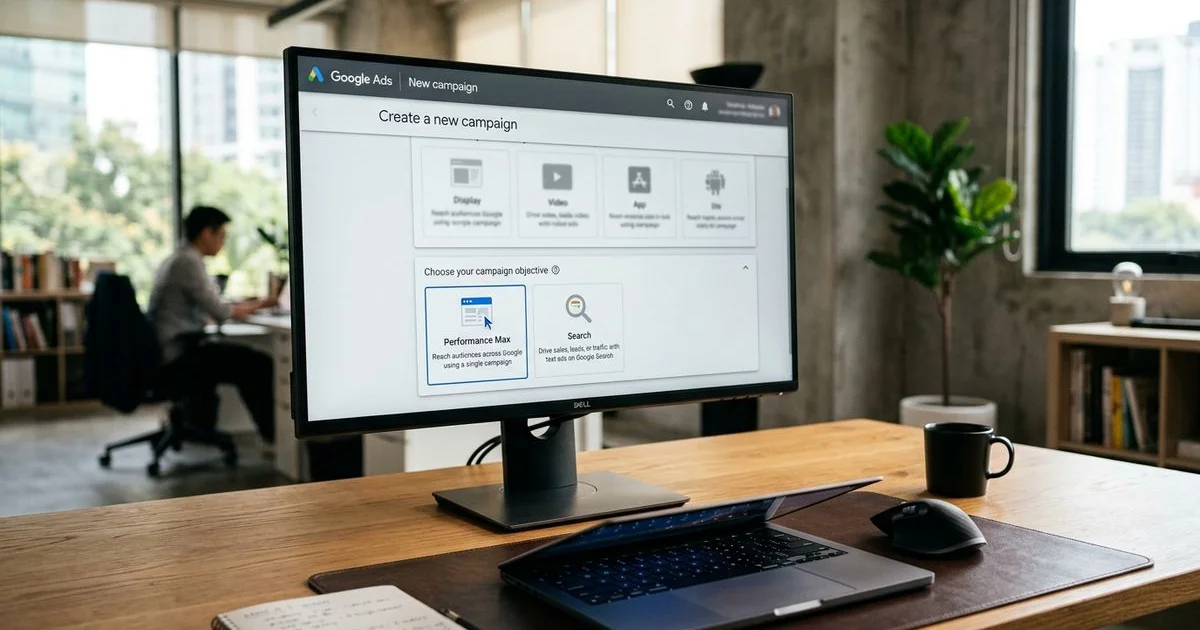
You know how hard it is to balance automation with control in your advertising mix. We often see business owners struggling to choose between the expansive reach of Performance Max and the precision of traditional Search. This choice is more critical than ever, especially with rising ad costs across the board.
We evaluate these options constantly for our clients, and you can see our approach At ADE Marketing. Performance Max offers a unified asset library that spans across Shopping, Display, YouTube, and Discover. Our team uses this automated format alongside classic keyword-driven text ads.
The right answer depends heavily on your specific account maturity and goals.
We will break down the exact performance max vs search ads differences and share a practical framework to help you decide. Let’s explore the data and find the best fit for your budget.
Side-by-side comparison
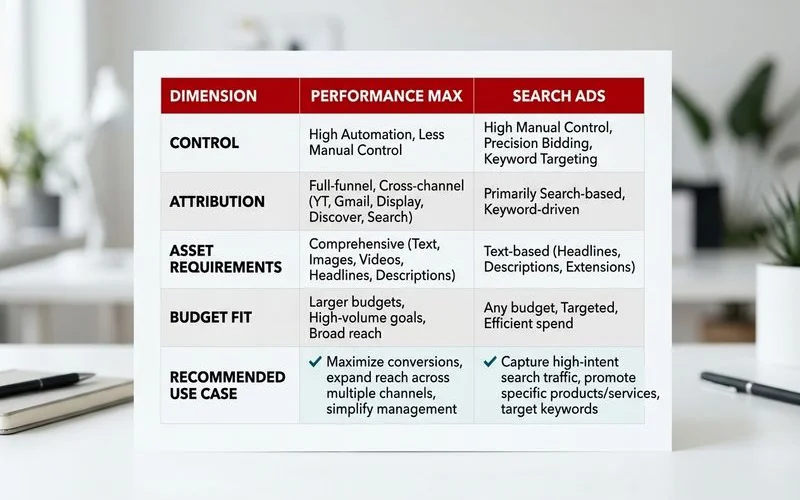
Comparing pmax vs search comes down to your need for control versus reach. We created this side-by-side view to highlight the fundamental differences in budget, assets, and data transparency.
| Dimension | Performance Max | Search Ads |
|---|---|---|
| Control | Limited. Google chooses placements, audiences, and creative combinations. | Full. You control keywords, bids, creative, and audiences. |
| Attribution clarity | Low. It operates as a black box at the placement and query level. | High. You get query-level data and full visibility. |
| Asset requirements | High. Needs 5+ images, 5+ headlines, descriptions, and optional video. | Low. Requires text headlines and descriptions only. |
| Surface coverage | All Google surfaces from one campaign. | Search only (unless layered with separate Display or YouTube). |
| Budget floor | RM5,000+ per month for meaningful learning. | Workable from RM1,000 to RM2,000 per month. |
| Average CPC (Malaysia) | Blended costs depend on the AI placement mix. | Averages RM1.50 to RM8.00 depending on the industry. |
| Best for | Mature accounts with strong assets and broad inventory. | Targeted intent capture, smaller budgets, and attribution-sensitive accounts. |
| Brand cannibalisation risk | High without active exclusions. | Low. |
| Conversion data needs | 30+ conversions per month minimum for stability. | Lower threshold; can stabilise on 10 to 15 conversions per month. |
A 2026 analysis of Malaysian e-commerce accounts shows that automated bidding drives over 80 percent of ad revenue. Our strategy aligns with this trend, but full automation is not always the right move for every local business.
When PMax wins
Performance Max delivers exceptional results when you have a proven sales funnel and a healthy budget. We see this automated system shine for established retail brands with diverse product catalogs.
A recent 2025 report from Optmyzr highlighted that this format excels at capturing broad demand across multiple networks. Our clients benefit most when they provide the algorithm with rich, high-quality visual assets.
- A mature advertising account: Stable Shopping and Search campaigns must already run profitably.
- A rich asset library: The system needs multiple high-quality images per product category, video assets, and varied copy to test combinations.
- Full-funnel conversion goals: You must track actions like Add to Cart, Initiate Checkout, and Purchase with clear monetary values.
- Broad product inventory: This format works best when you have many products spanning categories where the algorithm can find cross-surface demand.
- A supportive budget: You typically need RM5,000 or more in monthly ad spend to give the algorithm enough conversion data.
- Wired-up Brand exclusions: You must actively prevent the system from capturing your organic Brand Search traffic.
The algorithm thrives on volume and diverse data points. We find that giving the system at least 30 conversions per month is the minimum threshold for stability.
Accounts falling below this volume often experience erratic spending patterns. Our team always recommends building a strong foundation with traditional ads before transitioning your budget.
When Search wins
Traditional text ads remain the undisputed champion for precise targeting and clear attribution. We strongly recommend this classic approach for businesses selling high-value services or operating with limited budgets.
A 2026 industry review showed that Search CPCs in Malaysia average between RM1.50 and RM8.00. Our data confirms that capturing this high-intent traffic directly on the results page is highly cost-effective.
- Full attribution clarity is required: B2B, lead-gen, and considered-purchase models need to know exactly which query drove a specific conversion.
- Your budget is modest: Spending RM1,000 to RM3,000 per month works perfectly fine here, but it is not enough for an automated campaign to learn effectively.
- You offer a focused catalog: Businesses selling a small number of products or services lack the breadth that multi-surface algorithms need.
- Your asset library is text-based: Text-only ad creative works beautifully, avoiding the need for expensive visual media production.
- You target niche commercial keywords: Manual keyword targeting consistently beats algorithmic guessing on highly specific, low-volume terms.
- You operate in a sensitive vertical: Legal, medical, and regulated industries require strict control over ad copy and exact placement.
High-intent searches in competitive sectors like real estate or legal services can sometimes push CPCs to RM10 or RM15. We still prioritise these clicks because they represent customers actively looking to buy or hire today.
The PMax cannibalisation problem
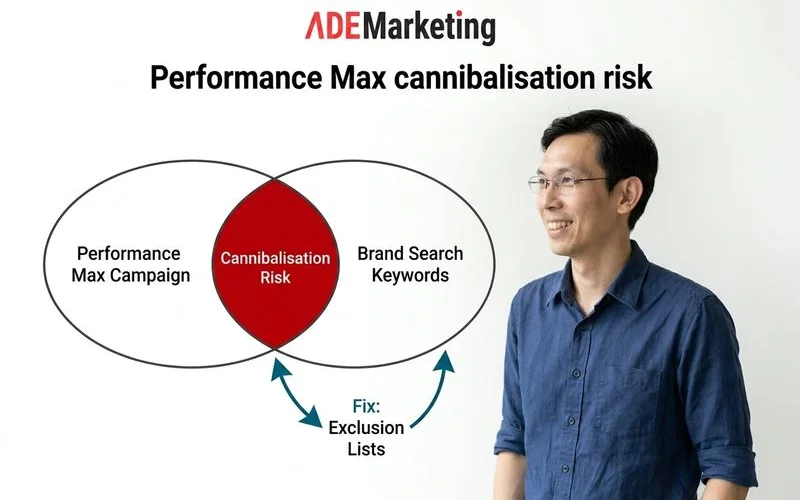
Automated campaigns will systematically target your own brand search queries if you do not restrict them. We consider this pmax cannibalisation the single most common and costly mistake in Malaysian advertising accounts.
A 2025 Optmyzr study confirmed that these automated systems frequently capture brand terms as low-hanging fruit. Our internal audits reveal that unrestricted campaigns can quietly burn 20 to 40 percent of your budget on traffic you should get for free.
- Add account-level brand keywords as negative keywords for your automated campaigns where supported.
- Apply Brand Exclusion lists directly within your specific campaign settings.
- Run a parallel Brand Defence text campaign at a low CPC to maintain control of your SERP real estate.
- Monitor your insights weekly to spot unexpected spikes in brand-related queries.
Failing to implement these safeguards distorts your reporting and inflates your perceived success. We always isolate brand traffic to measure the true incremental value of our marketing efforts.
Hybrid strategies: running both safely
The most profitable architecture layers these networks so they complement rather than compete with one another. We typically deploy a multi-tiered approach for mature e-commerce clients to maximise total revenue.
- Performance Max: Use this for general inventory demand capture and broad category-level discovery across all networks.
- Search (Brand): Deploy this for brand defence at a highly controlled, low CPC.
- Search (Non-Brand Commercial): Reserve this for specific, high-intent keyword themes where strict targeting control truly matters.
- Shopping (Standard): Maintain this as a control layer parallel to your automated efforts when your budget allows.
When configured correctly, these layers work together to capture users at different stages of the buying journey. Our specialists actively monitor overlapping targeting to ensure campaigns never bid against each other.
Data from 2026 shows that coordinated multi-platform strategies can outperform single-platform setups by up to 25 percent. We use this layered architecture to drive consistent, scalable growth without inflating our cost per click.
How ADE Marketing decides
Choosing the right path requires a hard look at your timeline, budget, and historical conversion data. We follow a strict 60 to 90-day validation period for all new local e-commerce engagements.
The typical starting blueprint prioritises stability and clear data collection. Our team launches Standard Shopping alongside dedicated Brand and Non-Brand text campaigns first.
- Start with Standard Shopping, Brand Search, and Non-Brand Search for the first 60 to 90 days.
- Validate your conversion tracking, build product feed quality, and stabilise your Cost Per Acquisition.
- Consider introducing a comprehensive google performance max guide strategy only after your asset library is prepared and exclusions are set.
Lead-generation clients in Malaysia require a completely different approach due to longer sales cycles. We keep these B2B accounts strictly on text-based campaigns because the murky attribution of multi-surface automation rarely justifies the investment.
For a deeper look into the broader retail decision, check out our guide on Google Shopping vs Search Ads. Our experts also provide a comprehensive Google Ads audit guide to help you evaluate your current setup.
Finding the perfect balance between control and automation takes patience and precise execution. We encourage you to review your current campaign structure and test these layered approaches carefully. When you are ready to implement these performance max vs search ads strategies, Talk to ADE Marketing.