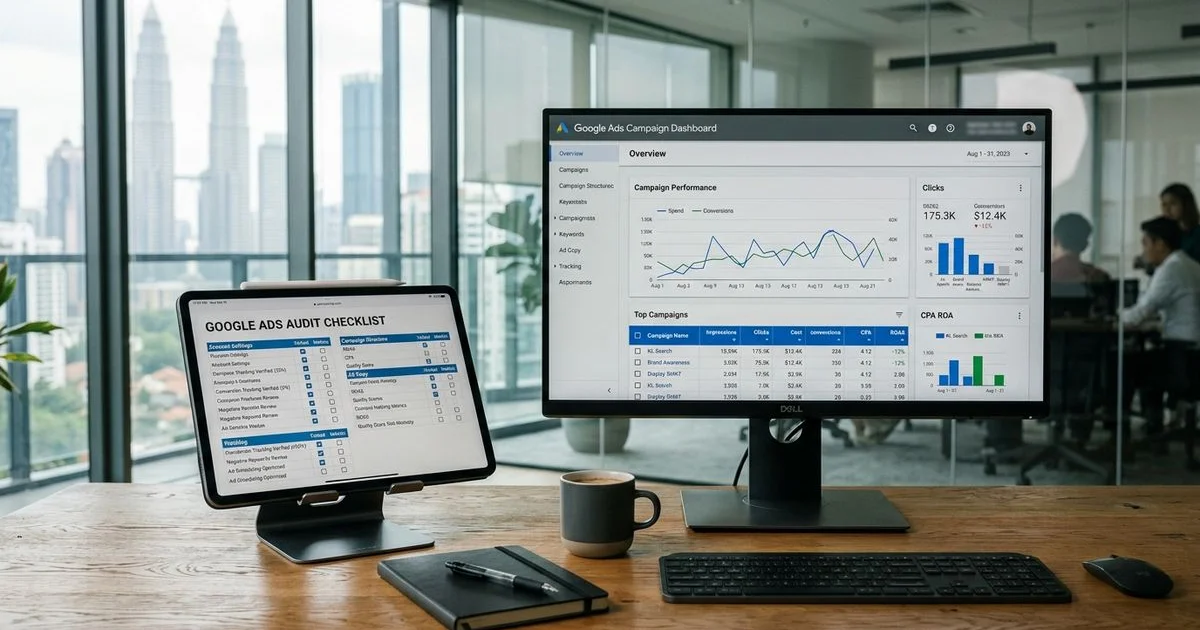
We see Google Ads accounts decay every single month. The structure that worked at launch drifts as keywords multiply and site updates break tracking.
Our team relies on a structured google ads audit every six months to stop this slide. You know exactly how fast cost-per-acquisition drifts when an account runs on autopilot.
Our research shows CPCs for high-intent industries in Malaysia climbing toward RM15 in 2026. This is what separates the standard accounts from the truly expensive ones.
We use this exact 12-point checklist at ADE Marketing to evaluate new prospect accounts. Let’s look at the data, what it actually tells us, and how to fix your setup today.
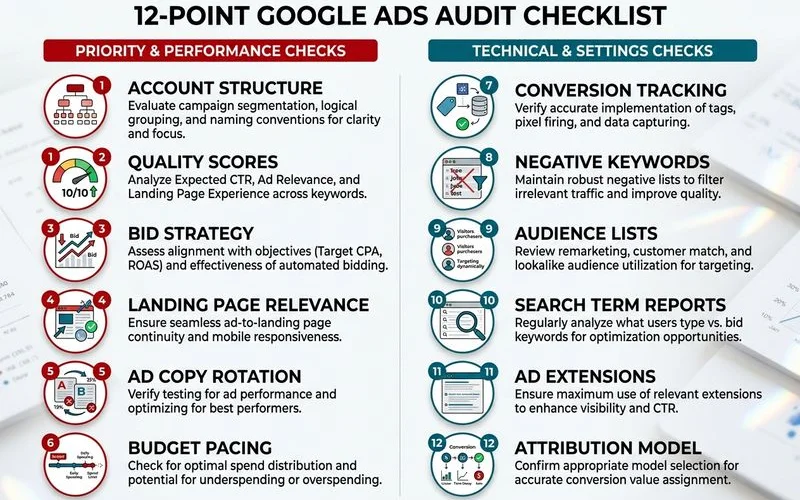
The 12-point audit
A complete ppc account audit examines structure, tracking, and ad quality to uncover wasted budget. Our audits systematically check these areas to avoid missing critical errors. The average account wastes up to 76 percent of its budget on poor targeting without regular checks.
1. Account structure
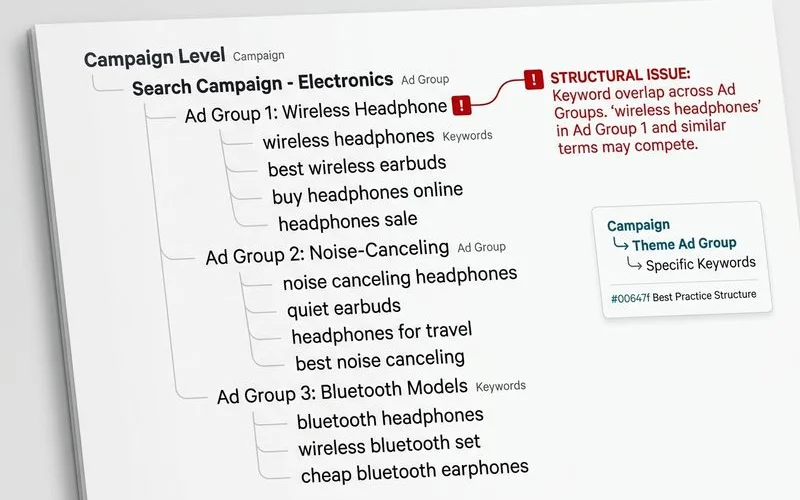
Campaigns must be organised by intent with tight ad groups of 5 to 10 closely related keywords. Our audits immediately flag any sprawl where 50 keywords share a single theme. The 2026 WordStream benchmarks prove that broad keyword targeting is a massive drain.
We see Malaysian SMEs waste thousands on generic terms instead of narrowing their location radius. This mistake spikes your costs by up to three times without driving new sales.
Here are the structural elements to review:
- Number of keywords per ad group.
- Match type distribution (exact match still converts best).
- Intent matching between keywords and ads.
- Location targeting accuracy.
Red flag: any ad group with more than 15 keywords or mixed-intent themes.
2. Conversion tracking integrity
Open Google Tag Assistant in Chrome and run a test conversion to verify your tracking. We check if the event fires correctly, avoids duplicates, and passes accurate revenue values. Inconsistent conversion tracking remains a top error in 2026 across most accounts.
Our experts often find that missing offline actions hides up to 64 percent of local revenue. You must use offline conversion tracking for any post-contact activities.
Common tracking failures include:
- Missing event triggers on forms.
- Duplicate tags firing twice per click.
- Zero-value revenue events for e-commerce.
- Missing call tracking extensions.
Red flag: missing events, duplicate events, or zero-value revenue events.
3. Quality Scores
Add the Quality Score, Expected CTR, Ad Relevance, and Landing Page Experience columns to your keyword view. We sort these ascending to find the most expensive problems fast. High Quality Scores actively reduce your cost per click in competitive auctions.
Our team knows that ignoring this metric guarantees you will overpay for traffic. You should check this at least once a month.
Red flag: more than 20 percent of impression-weighted keywords have Quality Score below 6.
4. Search-term report review
Look at the last 30 days of search terms to spot irrelevant paid traffic. We use this report to stop budget bleeding instantly. Globally, nearly 75 percent of Google ad spend goes specifically to Search campaigns.
Our analysts find that regular reviews of actual user queries prevent major losses. You must ensure these terms directly align with your offer.
Filters to apply:
- High clicks with zero conversions.
- Terms that contradict your location.
- Competitor names you do not want to target.
Red flag: more than 15 percent of last-month spend went to search terms not directly aligned with your offer.
5. Negative keyword hygiene
Check your negative keyword lists for campaign-level entries and shared lists. We build comprehensive negative lists to block junk traffic before it clicks. Words like “free” or “DIY” attract highly unqualified visitors.
Our data shows that blocking these terms cuts waste by nearly half for local service providers. You should add new negatives every single week.
Red flag: zero negatives added in the last 30 days, or no shared negative lists.
6. Ad copy testing
Review how many ad variations exist per ad group and if they use all available slots. We ensure responsive search ads utilize all 15 headlines and 4 descriptions. The average click-through rate for search ads sits around 3.17 percent.
Our audits frequently reveal that single, stale ads suppress this metric heavily. You must test different messaging against specific user intents.
Red flag: single ad per ad group, or RSAs not using all available creative slots.
7. Asset coverage (extensions)
Verify which assets are active, including sitelinks, callouts, and structured snippets. We use every relevant extension to maximize the physical size of the ad. Extensions reliably lift CTR by 10 to 30 percent.
Our team always implements location extensions for local clients in Malaysia. This specific feature allows drivers to route directly via Waze or Google Maps.
Essential assets to activate:
- Call extensions for phone leads.
- Location extensions for store visits.
- Sitelinks for deep navigation.
- Callouts for unique selling propositions.
Red flag: fewer than 4 active sitelinks per campaign, or missing callouts and structured snippets.
8. Audience layering
Attach observed audiences for visitor remarketing and in-market segments. We use observation mode to see which groups perform best before adjusting bids. AI-driven campaigns rely heavily on these specific audience signals.
Our strategy involves feeding the system custom intent data. This step biases the machine learning toward your ideal customer profile.
Red flag: no observed audiences attached to Search campaigns.
9. Bid strategy fit
Ensure your bid strategies match your actual conversion volume. We avoid automated bidding unless the campaign generates at least 30 conversions per month. A major mistake in 2026 is treating in-platform Return on Ad Spend as the only truth.
Our analysts always compare these numbers against actual business margins. You will make poor bidding decisions if you only look at Google’s reported figures.
Common bidding errors:
- Target CPA set too low for the market.
- Maximize Conversions on low-volume campaigns.
- Ignoring actual contribution margins.
Red flag: automated bidding on a campaign with fewer than 30 conversions/month.
10. Budget pacing
Check if your daily budget is hit consistently or if it exhausts by lunchtime. We analyze budget caps to ensure campaigns capture valuable afternoon traffic. Consistent early exhaustion signals your budget is too low for your targeting.
Our audits flag chronic under-spend as an impression share problem. You must adjust bids or targeting to fix this flow.
Red flag: consistent early budget exhaustion (signals budget too low) or chronic under-spend (signals impression share problem).
11. Landing page experience
Click each campaign’s primary ad and verify the page matches the search intent. We test mobile load speeds and the clarity of the conversion path during every check. The average conversion rate for landing pages sits at 2.35 percent.
Our data shows that top-performing pages in Malaysia can hit 11.45 percent. A slow mobile experience ruins your results because phones drive 95 percent of paid clicks.
Red flag: ads landing on homepage, slow mobile load times, unclear conversion path, or generic content not matching the keyword theme.
12. Reporting cadence
Determine how often someone actively reviews the account data. We recommend weekly manual checks to catch anomalies early. Automated tools like Adtunez help spot wasted spend daily.
Our team uses continuous monitoring to prevent budget leaks. You will save substantial money by catching issues within hours instead of weeks.
Red flag: reporting only when something breaks. The account needs regular eyes.
Scoring the audit
Tally your red flags on this google ads checklist to determine the necessary level of intervention. We use this scoring system to advise clients on their next steps. A low score means you just need some minor adjustments.
Our agency handles full rebuilds when the score gets too high. You can use this guide to make an informed decision.
- Zero red flags: Account is in healthy shape. Continue current management discipline.
- 1 to 2 red flags: Targeted optimisation work. Probably DIY-fixable if you have time.
- 3 to 5 red flags: Account drifted. Structured rebuild recommended, agency support often pays for itself.
- 6+ red flags: Account needs full rebuild. Continuing without intervention burns budget.
When ADE Marketing offers an audit
We offer a structured account audit before starting any retainer conversation. This process establishes trust right from the beginning. We share the findings honestly, even if you do not need our help yet.
The average Google Ads conversion rate for professional services in Malaysia is 4.2 percent. Our goal is to ensure your account exceeds these regional benchmarks. You can read more about the most common mistakes that surface in these checks.
Read about the frequent errors in our guide to common Google Ads mistakes. For the Quality Score deep-dive, see Quality Score explained. When you are ready, Talk to ADE Marketing for a free google ads audit on your account.