
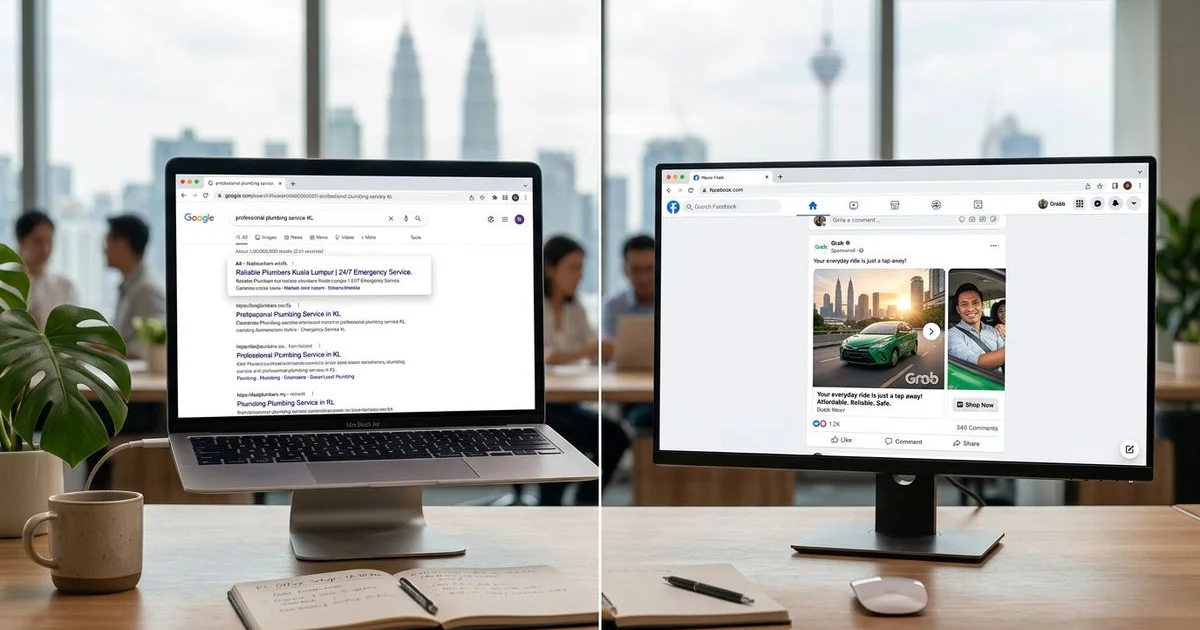
We frequently see Malaysian business owners struggling to choose between Google and Facebook. The debate often misses the most critical factor entirely.
A channel comparison that ignores how users actually behave will only produce confused budgets and disappointed clients.
Our SEM specialism is Google search, so we understand the mechanics of intent capture deeply. This guide breaks down the recent data, explains the regional cost per lead, and provides a practical way to allocate your budget.
The fundamental difference
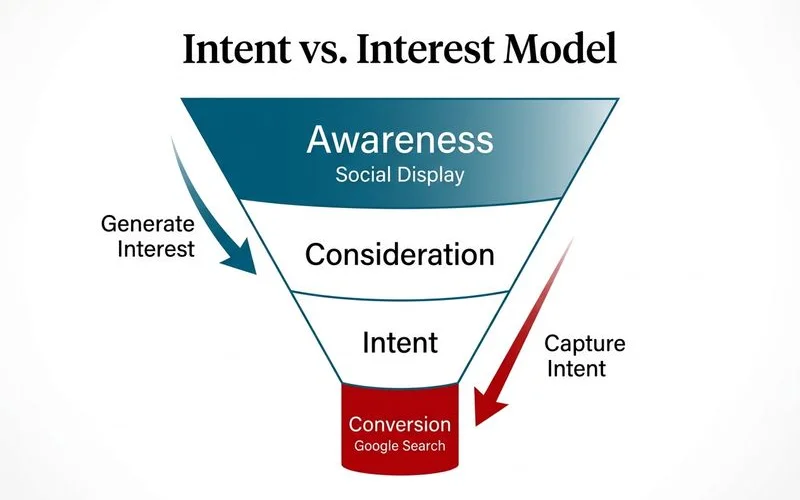
Google Ads captures existing intent. Someone is already searching for exactly what you sell. We know that with 98% internet penetration in Malaysia, search is the default tool for solving immediate problems.
Your ideal customer types a query, and your solution appears right at that moment. The core mechanics of the two platforms highlight this divide:
- Search Intent: Users actively looking for a specific answer.
- Social Interest: Users passively consuming content.
- Primary Trigger: Exact keywords versus broad demographic algorithms.
Our experience shows that Facebook Ads function entirely differently. They create or amplify interest by interrupting a user’s attention. Meta’s platforms reach over 31.84 million active users in Malaysia who are mostly scrolling for entertainment.
We find that successful social campaigns must use strong creative content to generate demand from scratch. This distinction shapes every tactical decision you will make. Ignoring it leads directly to wasted ad spend.
Cost-per-lead reality in Malaysia
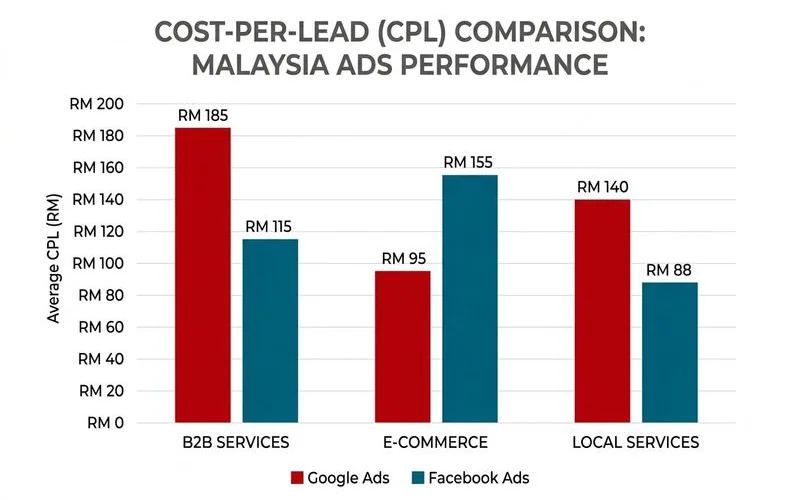
We regularly see headline cost-per-click numbers mislead business owners. A Facebook click might cost RM0.40, while a Google click might cost RM12.00 or more. These isolated figures hide the actual return on investment.
Our team focuses on the cost per qualified lead instead. This metric factors in conversion rate, lead quality, and downstream sales velocity. Average CPC for search campaigns in Malaysia typically ranges from RM 1.20 to RM 5.50 in 2026. Highly competitive industries like legal or B2B software often see costs climb up to RM 8.00 per click.
We advise clients to look beyond these initial click costs. A higher initial cost on search often results in a lower final cost per acquisition. Typical 2026 Malaysian benchmarks demonstrate this clearly:
| Industry | Google Ads CPL | Facebook CPL | Lead quality (Google vs Facebook) |
|---|---|---|---|
| B2B SaaS | RM150 - RM500 | RM50 - RM200 | Google leads 2 - 3x higher quality |
| Professional services | RM200 - RM800 | RM80 - RM300 | Google leads 3 - 4x higher quality |
| E-commerce | RM30 - RM120 | RM20 - RM80 | Roughly comparable; Facebook better for impulse |
| Local services | RM40 - RM150 | RM30 - RM100 | Google leads higher intent |
| Consumer brand awareness | N/A (wrong channel) | RM10 - RM50 (impressions) | Facebook owns this |
We find that Google’s higher cost per lead is usually offset by a significantly higher close rate for considered-purchase categories. B2B services and local trades see this advantage most clearly. The final sales pipeline tells the true story of channel performance.
When Google Ads wins
Google Ads is the clear winner when buyers are actively researching a purchase. Recent 2026 data shows that B2B buyers complete over 61% of their research before even contacting a vendor. Our campaigns use tools like Google’s AI Max to capture these prospects at the exact moment they form a decision.
You will see the best results from search marketing in these scenarios:
- B2B lead generation: Buyers research actively, and your offer matches their commercial query.
- Professional services: High-intent terms for legal, accounting, and advisory firms convert at high rates.
- Local services: Strong “near me” intent for trades like HVAC, plumbing, and dental clinics.
- B2B SaaS: Bottom-funnel keyword opportunities capture software evaluators comparing features.
- Comparison-stage e-commerce: Shoppers actively looking for high-consideration product purchases.
Search ads now increasingly appear inside Google’s AI Overviews. We leverage this placement to help businesses reach buyers much earlier in the research phase. Early visibility builds crucial trust before the final click. This approach consistently yields higher quality leads.
When Facebook (Meta) wins
Facebook and Instagram excel at creating demand where none currently exists. The platform works best when you need to introduce a new concept or drive impulse purchases. Our analysis of 2026 Meta Ads data reveals that creative volume is now the primary driver of success.
Meta’s AI handles the targeting automatically now. The algorithm needs a constant stream of fresh creative assets to test. We recommend using Meta Advantage+ to automatically optimise ad placements across their network.
Video formats are crucial for reaching younger demographics. Here is where Meta advertising truly shines:
- B2C impulse and discovery products: Fast-moving consumer goods, fashion, beauty, and lifestyle items.
- Brand awareness campaigns: Introducing a product category that nobody is searching for yet.
- Remarketing layers: Staying visible to prospects who have already interacted with your brand.
- Video-first creative formats: Engaging users rapidly through native short-form content.
- Community building: Direct-to-consumer brands looking to foster loyalty and engagement.
- Local event promotion: Utilizing highly specific geographic targeting to fill venues.
Video placements provide exceptional value right now. We consistently see Reels delivering 30% to 50% lower CPMs for Gen Z and Gen Alpha Malaysian audiences. This cost efficiency makes video a mandatory part of any social strategy. Static images simply cannot match the engagement rates of short-form video.
Running both: budget allocation logic
If you decide to run both channels, you need a clear strategy to prevent budget waste. Channel mixes must reflect the specific buying journey of your customers. We always suggest allocating funds based on what actually pulls a qualified pipeline.
The optimal split depends entirely on your business model. This table outlines common starting allocations for Malaysian SMEs:
| Business Type | Google Ads Allocation | Facebook Allocation | Primary Meta Strategy |
|---|---|---|---|
| B2B / Professional Services | 70% | 30% | Retargeting existing site visitors |
| B2C Impulse / D2C Brand | 30% | 70% | Broad discovery and video views |
| E-commerce Considered Purchase | 50% | 50% | Balanced acquisition |
| Local Service Providers | 60% | 40% | Community and area awareness |
Market conditions shift rapidly throughout the year. We advise clients to review this channel mix at least quarterly. You should adjust the percentages as you gather real conversion data. Flexibility prevents you from overspending on declining platforms.
Attribution challenges
Cross-channel attribution remains a significant hurdle for most businesses. A recent 2026 report noted that 78% of local consumers conduct online research across multiple platforms before buying. Our team sees this complex journey play out constantly in analytics.
Malaysian buyers frequently follow a chaotic path:
- They see a Facebook ad on their phone.
- They forget about the product for a few days.
- They search Google for the same category later.
- They click a Google Search ad.
- They finally convert on the website.
Google usually gets all the credit for that final click. Facebook then gets blamed for poor performance, even though it initiated the interest. We strongly recommend setting up data-driven attribution models in GA4 to help solve this.
This modern tracking approach distributes credit more fairly. You must still accept some level of data noise as part of the process.
ADE Marketing’s position
Specialising in what works best drives the highest return on investment. Concentrating resources yields better results than spreading them thinly. We focus exclusively on Google search marketing because intent capture is our strongest asset.
Many Malaysian SMEs require dedicated Meta campaign management. Finding the right agency for social media requires careful vetting. Our network includes trusted local specialists for those exact referrals.
Multi-channel campaigns require a unified approach to succeed. Someone must oversee how search and social interact. We act as the central SEO and SEM strategic partner across your entire sales funnel.
You might also be evaluating organic search against paid campaigns. The choice becomes much clearer when you review our detailed SEO vs Google Ads guide. Before you raise your Google Ads spend, work through the issues in our common Google Ads mistakes in Malaysia audit. Please Talk to ADE Marketing when you are ready to build a profitable search strategy.