

What technical SEO actually covers
You know how frustrating it is when a well-designed website fails to attract any local customers. Understanding what is technical SEO begins with recognising it as the foundation layer that determines whether search engines can crawl, render, index, and understand your site properly.
It essentially removes the hidden friction that stops your content from ranking.
At ADE Marketing, we open every project with a deep audit of these systems. This mandatory check ensures you never waste budget on a broken digital base.
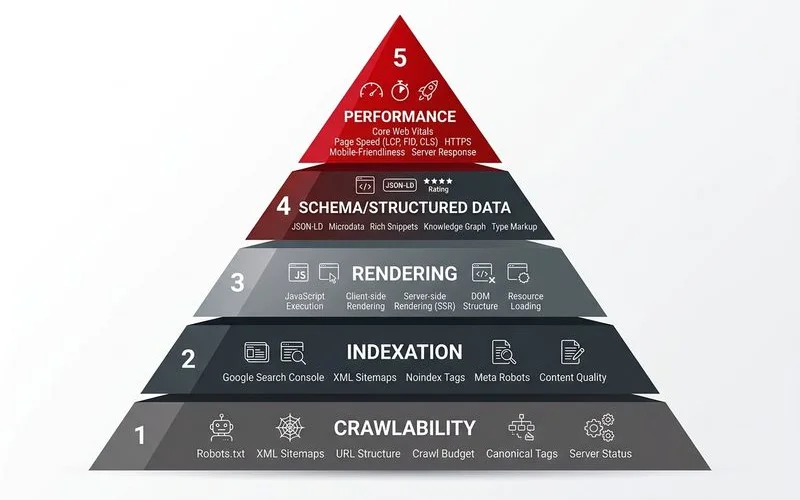
The technical surface area
The technical surface area covers five core disciplines that control your search visibility. Having technical SEO explained simply means looking at how these elements dictate how efficiently search engines process your website.
Five disciplines sit inside the technical bucket:
- Crawlability
- Indexation
- Core Web Vitals
- Rendering
- Schema and structured data
Crawlability
Can Googlebot reach every page that matters to your business? Crawlability covers server response codes, internal links, and how effectively you manage your crawl budget.
Large parameter URLs often drain this budget, leaving your main commercial pages ignored for months.
This is especially critical in 2026. AI crawlers like GPTBot and ClaudeBot rely entirely on your raw HTML.
They ignore JavaScript completely, so a clean crawl path is non-negotiable for modern search visibility.
Indexation
Out of the pages Google crawls, indexation determines which ones actually make it into the search results. This process relies on canonical tags, XML sitemaps, and proper duplicate content handling.
A common pitfall we see with Malaysian business sites is stuffing a single sitemap with over 50,000 URLs. This mistake causes massive indexing delays.
A better practice is splitting sitemaps by content type and ensuring your lastmod tags reflect genuine updates. Bloated indexes full of thin pages dilute your topical authority.
Core Web Vitals
Mastering core web vitals SEO means hitting the exact performance metrics Google uses to rank your site. Mobile shoppers are impatient, and industry studies show every additional second of load time increases bounce rates by around 7%.
Your target should be a full load in under three seconds on a standard 4G connection. Sites that fail these checks consistently underperform their competitors in mobile rankings.
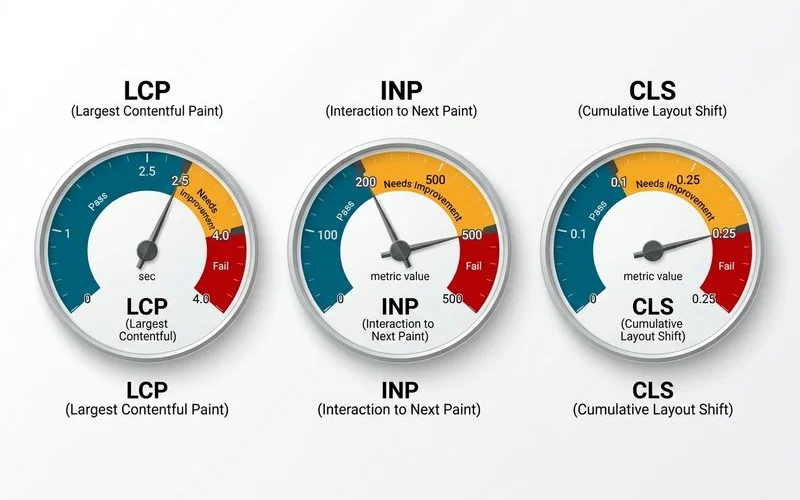
Here are the specific thresholds you must hit:
| Metric | Full Name | Target Goal |
|---|---|---|
| LCP | Largest Contentful Paint | Under 2.5 seconds |
| INP | Interaction to Next Paint | Under 200 milliseconds |
| CLS | Cumulative Layout Shift | Under 0.1 |
Rendering
Modern sites built on JavaScript frameworks face a serious rendering hurdle. Google crawls the HTML immediately, but executing client-side code can delay indexing by days or even weeks.
A critical 2025 Google update means search engines might completely skip rendering if your page returns a non-200 error code.
We highly recommend Incremental Static Regeneration (ISR) for 2026. This method serves fast, pre-rendered HTML to search engines while updating content in the background.
Schema and structured data
Schema markup is code that tells search engines exactly what your content is. Proper implementation feeds the Knowledge Graph and is vital for entity-based SEO in local markets.
A recent 2026 industry report showed that 73% of local business queries now trigger AI responses. These AI summaries rely heavily on LocalBusiness and Organization schema to verify facts.
Accurate markup can boost click-through rates by 20 to 40 percent. A March 2026 update now penalises sites using mismatched schema types, so precision is mandatory.
Why technical SEO is the foundation
Technical SEO acts as the digital plumbing for your website. You can redesign the frontend beautifully, but if the underlying pipes leak, your marketing efforts will fail.
When the technical layer breaks, every content piece fights invisible friction. Organic visibility is your best defense against rising advertising costs, but it requires a flawless technical base.
We see this rank stagnation frequently across Malaysian client sites. Cost-per-click rates for high-intent local keywords are rising rapidly in 2026, making organic traffic more valuable than ever.
Common Pitfall: Relying solely on client-side rendering is a massive liability. If a search bot cannot parse your scripts, your business is effectively invisible to AI-powered search engines.
A broken setup usually traces back to a few specific issues. Render-blocking scripts, accidental noindex tags left from a site migration, or sitemap errors are the usual suspects.
How ADE approaches technical audits
Our approach goes beyond running an automated checklist. Instead, the team diagnoses system behaviour exactly the way a software engineer would.
A recent 2026 Semrush report found that 72% of websites fail at least one critical technical factor. Adam’s computer-science background gives our team the edge needed to spot these deep structural flaws.
We have shipped multiple applications on modern stacks like React and Next.js. This hands-on experience shows us exactly how JS-heavy sites behave under Google’s scrutiny.
A standard technical SEO audit includes:
- Full crawl analysis using Screaming Frog and custom scripts
- Indexation coverage diagnosis directly from Search Console
- Core Web Vitals reporting by page template
- Schema implementation checks with strict rendering verification
- Internal link architecture maps to identify gaps
What to do next
If your site has not had a technical SEO audit in the past year, scheduling one is your mandatory next step. This diagnostic work will highlight the easiest wins before you spend money on new content or links.
It serves as a clear roadmap for your development team. A proper review prioritises fixes by impact and effort, ensuring you get the fastest return on your investment.
When you are ready to apply what is technical SEO to your own digital foundation, Talk to ADE Marketing. Our team will outline a strategy scoped perfectly to your site’s specific architecture.