
Ecommerce SEO in Malaysia is a different sport
From what I have seen across the industry, generic search strategies completely fall apart when applied to online stores.
Effective ecommerce SEO in Malaysia requires a much more specific approach. The sheer scale of managing thousands of URLs changes everything.
We know that standard playbooks produce standard results. This is exactly why Our SEO programmes include a highly specialised track for e-commerce.
Malaysia’s e-commerce market size reached USD 103 billion in 2025 according to IMARC Group, meaning the stakes are higher than ever. Our team frequently audits sites struggling with complex faceted navigation and confusing category structures.
To displace established competitors, you need a highly technical approach. Let’s look at the specific data and explore practical ways to respond.
Category page structure
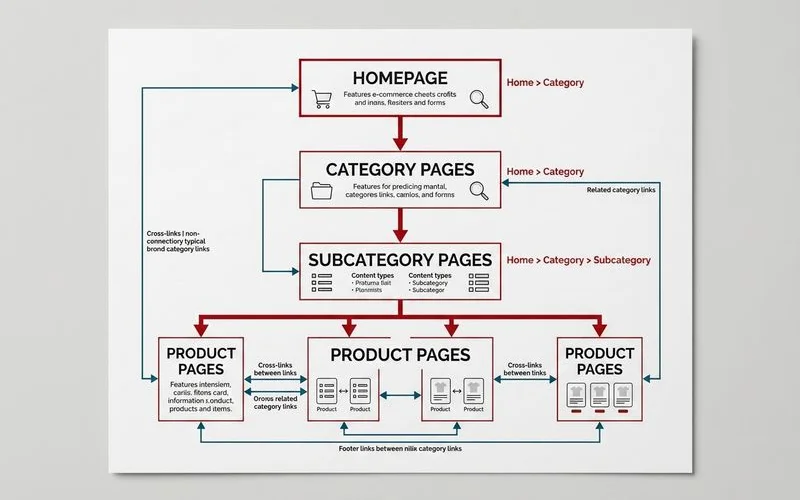
Category pages are the highest-value real estate for online stores in Malaysia. They target the broad commercial queries and feed authority to the product pages beneath them. A 2026 study by Digital Applied found that well-optimized category pages typically generate three to five times more organic revenue than individual product pages.
Our experience confirms that these pages capture shoppers right at the consideration phase. Buyers know what they want, but they are still deciding which specific item to choose.
A well-built category page must include:
- A unique H1 matching the primary intent keyword.
- 150 to 300 words of genuinely useful category context.
- Internal links to subcategories and key product collections.
- Filterable product grid with clean canonicalisation.
- Breadcrumb navigation with BreadcrumbList schema.
- A small FAQ section addressing the top buying questions for the category.
Recent April 2026 research analyzing top global e-commerce sites revealed the average number-one ranked category page contains just 310 words of unique content. We always advise clients to avoid stuffing these pages with generic filler text.
Focus entirely on providing clear, helpful buying context instead. Category pages without unique content underperform badly. The boilerplate template approach is one of the most common reasons local stores fail to rank against giant marketplaces like Shopee and Lazada.
Product page SEO and optimisation
Every product page should hit the technical and content basics to compete effectively. You need to give search engines clear signals while answering the exact questions a shopper has.
We treat these pages as the final conversion checkpoint. Missing structured data or poor image formatting will directly cost you sales.
| Element | What to do |
|---|---|
| Title tag | Product name + brand + key attribute + Malaysia (if local intent) |
| Meta description | 150 to 160 characters with a unique selling proposition and price hook |
| H1 | Product name |
| Schema | Product schema with offers, reviews, availability, brand |
| Reviews | User-generated content surfaced directly on the page |
| Images | Compressed, lazy-loaded, with descriptive alt text |
| Internal links | To category, sibling products, and related buying guides |
Product page SEO benefits enormously from review schema. Digital Applied reported in 2026 that enabling price, rating, and review count in search results increases organic click-through rates by an average of 30 percent compared to standard links.
Our testing backs this up completely. Each review snippet you surface gives shoppers a reason to click your listing over a competitor.
Faceted navigation: the silent killer
Faceted navigation options like filters for price, size, brand, and colour are the largest crawl-budget wasters in e-commerce SEO. A single category with five filter dimensions can spawn millions of near-duplicate parameter URLs.
Our technical audits often reveal that Google spends most of its time crawling useless filter combinations instead of actual products. This drains your site authority incredibly fast.
To maintain a healthy crawl budget, you must enforce strict indexation rules:
- Index filters that match real search demand, like specific brand pages or popular size variations.
- Canonicalise filters that are useful for users but not search, such as price ranges and sort orders.
- Noindex filter combinations with no realistic search demand.
- Disallow parameter URLs in robots.txt where indexation is not desired.
Implementing these URL parameter controls will protect your crawl budget and consolidate link equity correctly.

Schema for Product and Review
Malaysian e-commerce stores consistently leave structured data on the table. The Product schema with offers, availability, price, currency (MYR), and reviewer aggregate rating generates rich product results in the search engine results pages.
Our developers consider this foundational work for any store. It feeds directly into product visibility across Google surfaces.
To maximize your search visibility, your product schema must clearly define:
- Current product pricing in MYR.
- Accurate stock availability status.
- Aggregate review ratings from past buyers.
- Specific brand identifiers.
Google Merchant Center expects clean, current feed data. The feed quality directly influences organic search performance as well.
Our Shopping vs Search Ads comparison guide lays out exactly when each channel wins. If you are not running Google Shopping yet, you are missing out on highly qualified traffic. We recommend syncing both channels immediately to maximize your return on ad spend.
Platform-specific considerations for Malaysian e-commerce
Different platforms present unique technical challenges for search engine optimization. We have optimized stores across every major system used in Malaysia. Understanding these specific quirks will save you months of frustration.
Shopify SEO Malaysia challenges
Shopify provides a strong baseline, but URL structure constraints require specific workarounds. The platform creates duplicate paths for products using /collections/ and /products/ URLs.
Our strategy always involves fixing this canonical duplication to prevent authority dilution. Tag pages are another common trap that spread link equity too thin.
EasyStore SEO optimizations
EasyStore is incredibly popular among Malaysian small and medium enterprises. The platform offers decent default settings and integrates well with local payment gateways like FPX and GrabPay.
We find that meta templates, schema markup, and category content still need manual work. You must actively optimize these specific areas:
- Customizing title tags beyond the default templates.
- Adding detailed product schema for rich snippets.
- Injecting unique content into category descriptions.
This extra effort is necessary because the default settings are not enough to rank competitively.
WooCommerce functionality
WooCommerce is the most flexible option available today. It is also the most likely to ship with bloated themes, render-blocking JavaScript, and poor Core Web Vitals.
Our team strongly recommends going beyond the basic schema provided by plugins like Yoast. High-performing stores require custom technical configurations to load quickly on mobile devices.
“A one-second delay in mobile load times can drop e-commerce conversion rates by up to 20 percent, making Core Web Vitals critical for WooCommerce.”
Custom-built frameworks
Custom builds offer complete control, but they also bring full responsibility for every technical detail. This path is best for high-volume operators willing to invest in proper engineering.
We only suggest this route if your catalog scale demands features off-the-shelf platforms cannot provide.
Where e-commerce SEO meets paid
Organic e-commerce search visibility and Google Shopping are not separate channels in practice.
Merchant Center feed quality lifts both disciplines simultaneously. Our media buyers rely on Shopping ad data as one of the cleanest signals to inform organic category targeting.
This shared intelligence accelerates revenue growth.
“Treating organic search and paid shopping as a single, unified ecosystem is the fastest way to capture high-intent commercial queries in the Malaysian market.”
For Malaysian stores running both channels, coordinating the search and paid work in parallel is essential. This discipline requires the exact kind of full-stack search competence ADE Marketing brings to the table. Our local SEO Malaysia guide covers the city-level visibility layer that complements category-page work.
We align keyword strategies with buying intent so product URLs rank for terms that actually convert. When you are ready to scale, Talk to ADE Marketing about a coordinated ecommerce SEO in Malaysia engagement.