We notice many business owners struggle to maintain their search visibility despite publishing new content weekly. This frustration usually stems from relying on tactics that stopped working years ago. The rules of online discovery have fundamentally changed.
Search engines now function as intelligent answer engines. They connect concepts rather than simply matching text strings.
Let’s look at the data, what it actually tells us, and explore practical ways to respond.
The shift Google made years ago
For most of search history, optimization meant picking a keyword and stuffing it onto a page. That specific model worked fine when algorithms simply matched strings of text. Things changed dramatically in 2012 when the Knowledge Graph officially launched.
Google evolved from reading words to understanding real-world concepts. Several major algorithm updates cemented this shift:
- Hummingbird: Introduced semantic search capabilities.
- RankBrain: Applied machine learning to understand search intent.
- BERT and MUM: Mastered natural language processing to read context.
We know that treating search as a keyword-matching exercise in 2026 is a losing battle. A 2026 study by Stackmatix revealed that AI Overviews now appear at the top of 58% of all search results. This data proves search engines prefer synthesising answers using structured data over listing plain links.
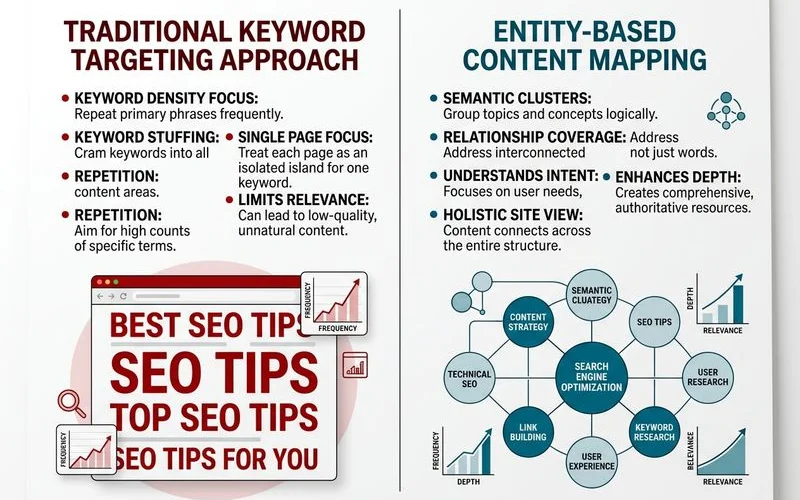
At ADE Marketing we plan content as entity coverage first and keyword targeting second. The difference shows up clearly in your ranking quality, traffic durability, and direct AI search visibility.
What “entity” actually means
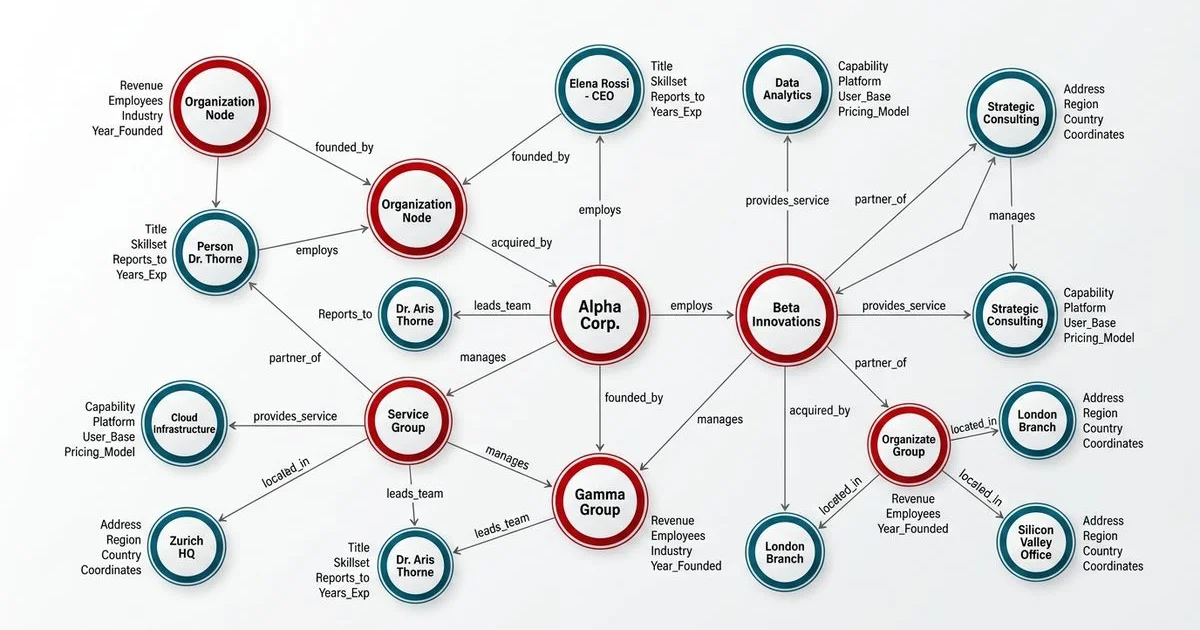
An entity is a distinct, recognizable thing that exists independently of its name. “Adam Yong” is an entity, and so are “ADE Marketing”, “Searchathon 2020”, and “Kuala Lumpur”. Other examples include concepts like “Generative Engine Optimization” or “Core Web Vitals”.
Every single entity possesses two core characteristics:
- Attributes: Properties that describe the subject, such as a founded year, location, or industry.
- Relationships: Clear connections to other entities, like “Adam Yong is the founder of ADE Marketing”.
We view Google’s Knowledge Graph as a massive, structured database housing these entities. Search algorithms no longer just look for matching phrases. They actively try to comprehend which specific entity a user is asking about and which related concepts provide the best answer.
A powerful detail many business owners miss is that unlinked brand mentions also count. Google search representatives have confirmed the algorithm picks up company names across the web, even without a direct backlink. Your business is an entity, and building a strong digital footprint requires consistent mentions across credible Malaysian directories and news sites.
Why string-matching keyword targeting is no longer enough
Three specific reasons make traditional keyword-only strategies fail in 2026. The shift toward AI-driven results requires a completely different approach.
- Search engines ignore keyword stuffing: Synonym recognition and intent matching mean repeating a phrase twelve times does nothing. Over-inserting keywords into Bahasa Malaysia or English content now signals low quality to the algorithm.
- Queries map to multiple intents: Google routes searches based on entity intent rather than just text strings. You must match the underlying concept behind the question to rank.
- AI Overviews favour entity-rich content: The synthetic AI layer reaches for structurally coherent information. Recent 2026 analysis by DataSlayer highlights a 61% drop in organic clicks for standard links when an AI Overview is present.
We strongly suggest focusing on becoming a cited source within those AI answers. Brands cited directly inside the overview experience a 35% click-through lift, according to 2026 data from Seer.
This massive shift means your strategy has to start with a clear question. Ask yourself what the page is actually about in terms of entities, rather than just what keyword it targets.
The role of schema.org and JSON-LD
Schema markup provides the explicit code needed to tell search engines exactly which entities your content covers. Google builds its Knowledge Graph from structured data signals found everywhere on the web. This code feeds your company’s direct representation into that database.
We see a distinct competitive disadvantage for local businesses ignoring schema SEO. Local “near me” searches in Malaysia have surged 150% since 2022, and AI engines use structured data to extract details for these specific queries.
For a Malaysian business, the schema priority stack includes:
| Schema type | Why it matters |
|---|---|
| Organization (or LocalBusiness / ProfessionalService) | Establishes your business as a recognized entity |
| Person | Surfaces founders and senior practitioners |
| Service | Maps your local offerings to discoverable entities |
| Product | Defines specific e-commerce product entities |
| Article | Provides explicit authorship signals for content |
| FAQPage | Feeds exact question entities into AI extractions |
| BreadcrumbList | Clarifies your hierarchical site context |
Properly implementing these tags gives Google a clean path to understanding and citing your content.

Practical implications for content briefs
Our content briefs now begin with entity coverage rather than an outdated keyword density target. This ensures the writing process aligns with how modern algorithms evaluate topical authority and semantic SEO.
The brief must explicitly specify several core elements:
- The primary entity the page addresses.
- Related entities requiring coverage, including sub-topics and attributes.
- Internal linking targets that reinforce entity relationships.
- Specific schema markup to make the entity explicit to search engines.
- Authoritative external citations to build trust.
We consider topical authority absolutely critical for industries like finance, health, and legal services. Google’s Quality Rater Guidelines demand demonstrated expertise, and a brief focused purely on keyword volume will fail that test.
Agility Writer, our content SaaS, was built entirely around this necessary discipline. It analyses the live search results for a target query and extracts the exact entities Google already rewards. The final output provides a brief that covers the complete entity universe, ensuring your content satisfies both human readers and AI systems.
Tie-back to founder background
The fundamental shift to entity-based SEO strategies highlights why Adam’s computer-science background heavily influences our practitioner level work. Entity optimization is structurally a complex graph problem requiring specific technical skills:
- Managing isolated data nodes.
- Plotting relationship edges between concepts.
- Understanding how search crawlers traverse this structured data.
Software engineers naturally see this underlying structure. Marketers without a technical background often default to keyword density simply because it feels familiar.
We approach content strategy much like structural database management. Advanced frameworks like LangChain help map out complex industry knowledge graphs before anyone writes a single word. This technical foundation builds authority across an entire topic systematically, which is the core of knowledge graph SEO.
Why this matters even more for GEO
Entity-based structure forms the absolute foundation if you care about AI search visibility. Generative Engine Optimization requires feeding clear data to AI platforms like ChatGPT, Gemini, Perplexity, and Claude. These engines ground their answers entirely in entity-structured data.
A growing share of searches now runs through an AI layer before a human ever sees a blue link, whether that is an AI Overview, a chatbot answer, or an agent researching on a buyer’s behalf. The exact same schema coverage that helps you rank on traditional Google also secures your citations in these new AI answers.
We constantly remind clients that skipping this step now costs you twice. You lose ground in classical rankings and remain completely invisible in AI-generated summaries.
The financial impact of adapting
The business case for making this technical upgrade is strong. The traffic that clicks through from an AI citation arrives highly qualified: the AI has already answered the buyer’s comparison questions and named you as the recommendation.
We can help you secure the visibility your business deserves.
When you feel ready to update your digital presence, Talk to ADE Marketing about an engagement built on strict entity discipline.