Stop framing it as either-or
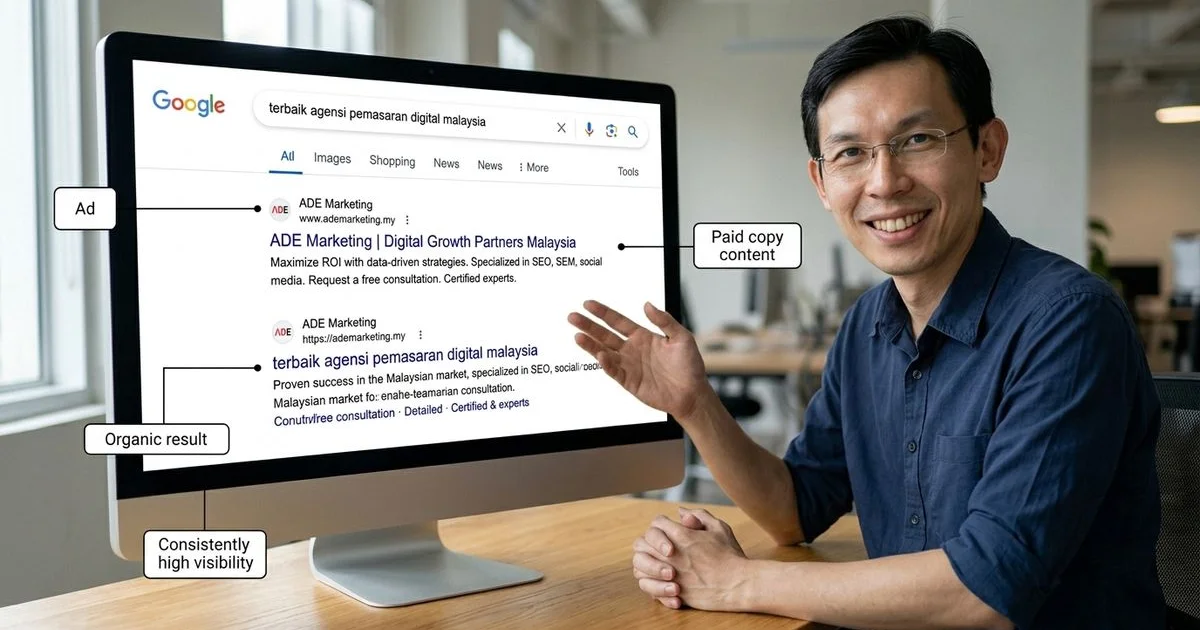
You know how almost every strategic marketing conversation eventually loops back to the classic SEO vs Google Ads debate. We constantly see local business owners treating this PPC vs SEO Malaysia comparison like a forced choice, but this specific framing is actually the wrong approach.
The real question is which exact mix of organic vs paid search matches your current growth stage. Each channel performs highly specific functions incredibly well for local companies.
Choosing the incorrect path rapidly burns through cash and wastes precious time.
Let’s look at the actual performance data for both channels. Our team will then break down a practical allocation framework to help you set the right strategy for the year ahead.
The side-by-side
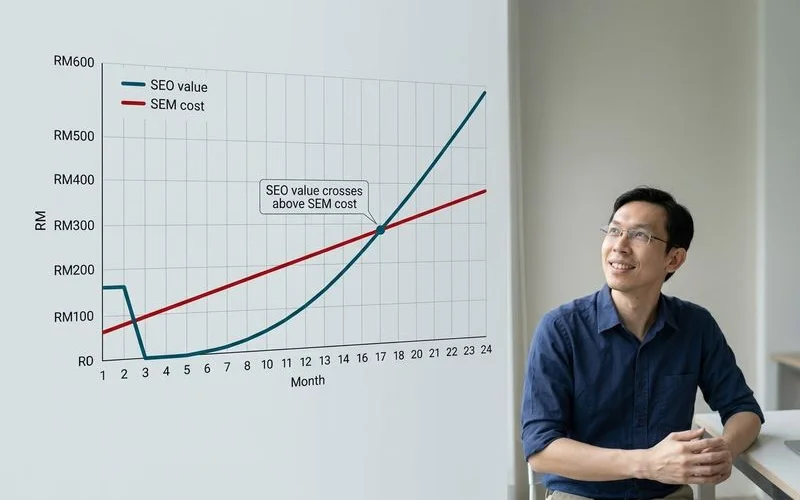
Both channels offer unique advantages when evaluated across core business metrics. A direct comparison makes the strategic differences immediately clear. We evaluate these platforms side-by-side to prevent expensive missteps in your digital strategy.
| Dimension | SEO | Google Ads (SEM) |
|---|---|---|
| Speed to first lead | 3 to 6 months | 7 to 14 days |
| Cost trajectory | Mostly fixed; declining per-lead at scale | Scales with traffic; per-lead can be stable to rising |
| Durability | Compounding equity; survives spend pauses | Channel stops the moment budget stops |
| Intent capture | Wider funnel, research to decision | Narrower, mostly bottom-funnel commercial |
| Attribution clarity | Harder, multi-touch, long path | Cleaner, click-attributable |
| Brand-building effect | High, top organic positions equal trust | Limited, paid clicks build less brand |
| Best for new domains | Slow start, big payoff | Works immediately |
| Best for established domains | Excellent | Excellent |
| Best for B2B | Excellent, long sales cycles | Strong for specific bottom-funnel queries |
| Best for B2C / e-commerce | Strong | Excellent, especially Shopping |
| Susceptibility to AI Overviews | Some risk, CTR pressure | Largely unaffected, paid space protected |
Google continues to update its AI Overviews in 2026. This rollout impacts traditional organic click-through rates across Malaysia. Paid search real estate remains largely protected from these top-of-page shifts.
When SEO wins
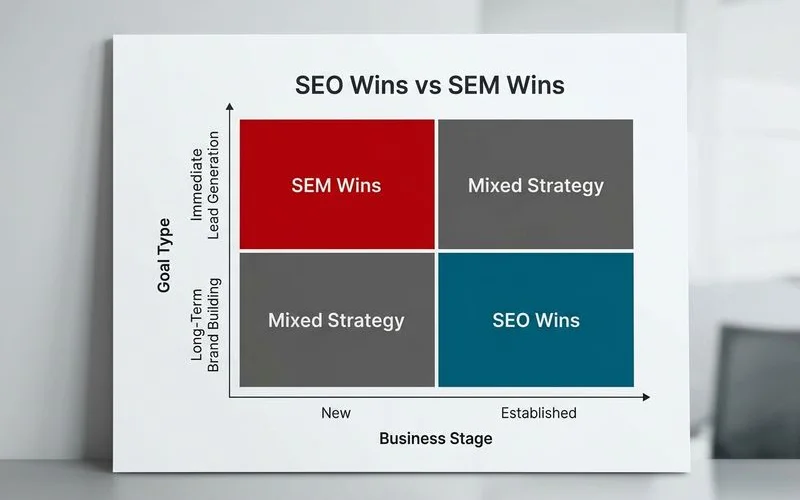
Organic search dominates when your primary objective is building compounding marketing equity. This approach requires patience but significantly lowers your customer acquisition cost over time. We regularly see mature campaigns generating leads at a fraction of the cost of paid channels.
- You need long-term equity. Organic rankings compound your investment. Year three operations are dramatically cheaper per lead than year one setups.
- You operate in B2B or considered-purchase categories. Recent 2025 industry data shows that B2B buyers complete nearly 70% of their research online before reaching out. These diligent buyers reward companies they find naturally in search results.
- You own an existing domain with decent authority. Sites with established Ahrefs Domain Rating scores rank much faster on their current foundation.
- You want defensible positioning. Competitors struggle to quickly displace deep organic equity. Paid bidding wars, on the other hand, change daily.
- You target niche markets. Specific commercial keywords often feature lower organic competition compared to aggressive paid auction environments.
When SEM wins
Paid search campaigns win outright when your business requires immediate pipeline velocity. No organic programme can match the rapid lead generation of a properly tuned Google Ads setup. Our specialists use paid campaigns to validate market demand before committing to long-term content strategies.
- You need leads in 30 to 90 days. Campaigns often generate initial inquiries within the first two weeks of launch.
- You require controlled scaling. A flexible budget allows you to dial traffic up or down with high predictability.
- You sell time-sensitive offers. Promotions, holiday sales, and event campaigns rely entirely on instant visibility.
- Your conversion path is clean. Google Ads Performance Max campaigns excel when the click-to-conversion journey is short and trackable.
- You want to test market demand. Paid data reveals exactly which products, messages, and price points convert best. You can then use these exact insights to direct your broader organic content strategy.
Why most Malaysian B2B firms benefit from running both
Combining organic and paid strategies creates a powerful multiplier effect for your digital presence. Most local businesses struggle because they isolate these two highly complementary channels. We strongly advise integrating them to cover both immediate needs and future growth.
The Three-Year Phased Approach
The pattern we execute across B2B retainers follows a highly predictable timeline. Budget allocations naturally shift as organic foundations mature.
- Year 1: Paid search carries the lead volume while organic foundations take root. Your budget typically skews 60% paid and 40% organic.
- Year 2: Organic traffic begins compounding noticeably. Funding shifts to a 40% paid and 60% organic split as your overall cost per lead drops.
- Year 3 and beyond: Organic search carries the vast majority of your qualified pipeline. Paid campaigns simply top up gaps, handle seasonal spikes, and test new offers. A 30% paid and 70% organic split becomes the standard.
The Hidden Coordination Advantage
Running both channels simultaneously creates a massive data advantage. Your Google Ads Search Terms report provides exact, converting phrases to target organically. Recent 2025 case studies show this cross-channel data sharing improves organic traffic efficiency by up to 35%.
Most agencies miss this coordination entirely because they operate in strict silos. We manage both internally to guarantee these insights inform your total SEO vs SEM strategy.
A practical allocation framework
Establishing a baseline budget mix provides a clear starting point for any growing company. For Malaysian SMEs with a credible digital budget of RM 10,000 to RM 30,000 monthly, establishing a sensible default prevents overspending. We adjust these ratios quarterly based on concrete pipeline data.
Recommended Starting Ratios
Your specific industry and maturity level dictate your initial budget split.
- Early-stage SME: Allocate 30% to organic and 70% to paid. You need fast revenue, and organic efforts build quietly in the background.
- Mature B2B firm: Balance the mix at 50% organic and 50% paid. Both channels have historical data, allowing you to maximize absolute reach.
- E-commerce operator: Dedicate 40% to organic and 60% to paid. Google Shopping ads dominate product searches, while category-level organic pages compound over the long term.
These percentages serve simply as starting points. Your team must adjust this strategy every quarter depending on which channel actually generates closed deals.
What to do next
Choosing between organic and paid search usually comes down to your immediate cash flow requirements. Start with paid campaigns for raw speed, and run your organic strategy in parallel for the long game.
You can try an organic-first approach only if you have a 12-month patience window and an already established website. If timing is the bigger question, our SEO timeline guide for Malaysia sets honest expectations for when organic begins to pay back.
Our team at Talk to ADE Marketing will review your stage, analyze your domain, and evaluate your goals. This data-driven analysis guarantees an honest recommendation for your ideal search allocation.