

The direct answer
Business owners frequently ask how long until google ads work for their specific industry. For most Malaysian B2C lead-gen campaigns, Google Ads typically reaches a stabilised Cost Per Acquisition (CPA) in 30 to 90 days.
B2B campaigns with longer sales cycles often need 60 to 90 days.
Our professional service team considers a campaign “stabilised” when the cost per acquisition settles into a predictable, manageable range. Week-over-week variance normalises at this stage.
We build the first 90 days of ADE Marketing’s SEM engagements around this explicit expectation. Week-by-week milestones replace the blind hope of waiting for good results.
Our strategy relies on reading the data correctly to make confident, aggressive budget decisions. E-commerce campaigns with clean conversion tracking can achieve this stability inside 30 to 45 days.
We will break down the reasons behind this PPC timeline and share the exact practical steps you can take to manage early costs.
What Google is doing during the learning phase
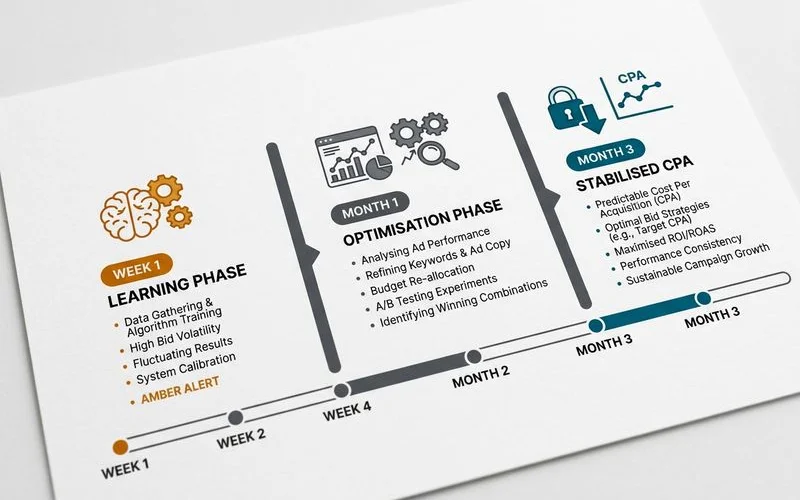
The first 7 to 14 days of any new campaign act as a mandatory data-gathering period for Google. The algorithm actively tests bids, audiences, and ad combinations to see what actually drives commercial results.
We know from 2026 data that Google’s Smart Bidding requires up to 50 conversion events to calibrate fully. The system experiments with different variables during this window, causing noticeable performance swings.
During this volatile google ads learning phase:
- CPA sits high, often two to three times the eventual stable target number.
- Click-Through Rate (CTR) remains volatile while the system tests new responsive search ads.
- Quality Score is provisional and updates daily based on user interaction.
- Conversion rate is unreliable due to small, fragmented sample sizes.
Our strict rule is to launch with the right structure and let the campaign run without manual interference. Touching the settings too much during this initial window resets the algorithmic data completely.
We remind clients constantly that real discipline involves resisting the urge to optimise based on early noise.
What changes week by week
A typical campaign progression moves from aggressive algorithm testing to refined budget scaling over three months. The focus shifts entirely from structural fixes to performance expansion.
We follow a specific milestone roadmap for every Malaysian client to establish a clear google ads roi timeline. The table below outlines the exact expectations.
| Phase | Days | What is happening | What we optimise |
|---|---|---|---|
| Learning | 0 to 14 | Algorithm gathering conversion data | Negative keywords from search-term reports; ad copy obvious issues |
| Early optimisation | 15 to 30 | First clear CPA picture forms | Bid strategy tuning, ad copy testing, audience refinement |
| Mid optimisation | 30 to 60 | CPA trending toward target | Landing-page CRO work, ad asset expansion, geo and time-of-day refinement |
| Stabilisation | 60 to 90 | CPA settling into stable band | Scale budget; expand to similar keyword themes; test PMax (carefully) |
Our data analysts note that Performance Max (PMax) campaigns often require a full 4 to 6 weeks to exit the learning phase. You must allow this extra time if you rely heavily on AI-driven placements across multiple Google networks.
Why early-month CPA is misleading
Early-month CPA numbers consistently look inflated because algorithms spend money testing inefficient placements before finding the winners. Conversion attribution naturally lags behind the initial click.
We frequently see campaigns that read a RM150 CPA in week one drop and stabilise at RM55 by month two. The immediate dashboard view simply misses the full conversion picture.
The reality of B2B conversion lags
A typical Malaysian B2B buyer in 2026 requires 8 to 12 touchpoints before submitting a lead form. Many buyers take 2 to 4 weeks from their first Google Search click to actually convert.
Our analytics show that early-week conversion reports systematically understate the campaign’s actual performance. Last-click attribution models fail to capture this multi-day research process accurately.
We find that the right metric to watch in weeks one and two is search-term quality rather than cost per acquisition.
Early indicators of success
You should look for commercially relevant searches triggering your ads immediately.
Our specialists verify that negative keywords are applied daily to filter out junk traffic and protect the budget. An improving Quality Score serves as another strong early signal that the campaign is on track.
When to pull the plug
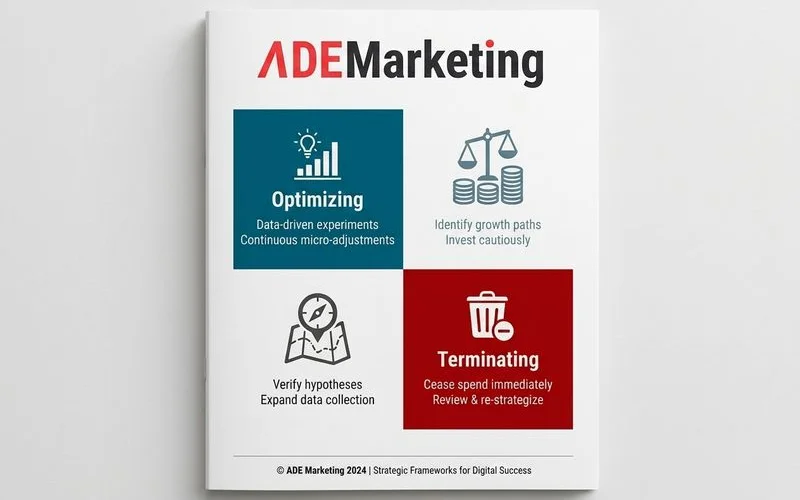
A campaign warrants killing when costs remain three times higher than the target after 60 to 90 days of disciplined adjustments. You must stop if there is no clear improvement trajectory in the search data.
Our internal guidelines require pausing a campaign for any of the following specific data triggers:
- Quality Scores stick at 4 or below across primary keywords, which carries a massive 64% CPC penalty.
- Conversion volume stays too low to feed the algorithm (fewer than 15 conversions per month at month two).
- The market proves genuinely too competitive at your current daily budget level.
- Landing page updates fail to close the conversion-rate gap.
We never kill a campaign just because the week-one CPA looks bad. The numbers always start high while the system learns.
Our team ignores temporary competitor out-bidding or short seasonal traffic dips. You should avoid making permanent decisions based on emotional reactions to day 20 dashboard metrics.
When to stay the course
You should keep the campaign active if the CPA trends downward after 30 days and search-term reports show highly relevant queries. Improving Quality Scores indicate the system is successfully finding your target audience.
We recommend adding to the budget cautiously once you hit 30 consistent monthly conversions. The AI algorithms need this baseline volume to maintain stable, predictable bidding.
Our standard practice is to refresh ad copy quarterly and let the performance data compound over time. Consistent discipline yields the highest return on investment.
A note on small Malaysian SME budgets
The standard 60 to 90 day learning curve applies to all accounts, but smaller budgets stretch this timeline out. Lower daily spending means it takes more days to hit the 50 conversion events required for algorithm stability.
We advise Malaysian SMEs spending under RM3,000 monthly to expect a 90 to 120 day stabilisation period. You must consider whether a micro-budget is enough to compete in your specific industry auction against larger players.
Our team recommends specific strategies for limited budgets:
- Focus on high-intent search terms rather than broad awareness keywords.
- Limit geographic targeting to your most profitable local radius.
- Utilise the RM150 million SME digitalisation grants allocated in the 2026 Malaysian Budget.
We suggest reviewing the common Google Ads mistakes wasting Malaysian SME budgets to protect your initial investment. Proper planning prevents wasted ad spend.
Our agency builds 90-day milestones into every project to ensure clear expectations and measurable progress. Talk to ADE Marketing when you are ready for a structured, data-driven SEM engagement.