

The strategic question, plainly
Malaysian business owners and homeowners face two distinct ways to find services and make purchasing decisions. We observe this directly when analysing local search behaviour, as traditional Google results run parallel to AI-driven answers. Understanding the mechanics of SEO vs GEO is critical because operators must manage two primary discovery paths by 2026:
- Classical search: Google controls this space through traditional blue links, the local map pack, and image or video carousels, with SEO governing your visibility.
- AI search: ChatGPT, Google Gemini, Perplexity, Claude, and Google AI Overviews dominate this surface, while Generative Engine Optimization controls your presence here.
These two surfaces work together sequentially rather than competing. Homeowners often start their research in an AI engine to shortlist local contractors, and then use classical search to validate reviews or find contact details.
As of April 2026, Statcounter data shows ChatGPT holding a massive 72.6% market share among AI chatbots in Malaysia.
Missing your brand from either surface means losing a significant share of a buyer’s attention.
We designed this guide to provide a high-level strategic framework for this dual reality. Tactical execution for AI visibility Malaysia campaigns lives at ADE GenCite, our specialised division. The /geo/ hub on this site serves as your strategic bridge to understand these concepts.
SEO vs GEO at a glance
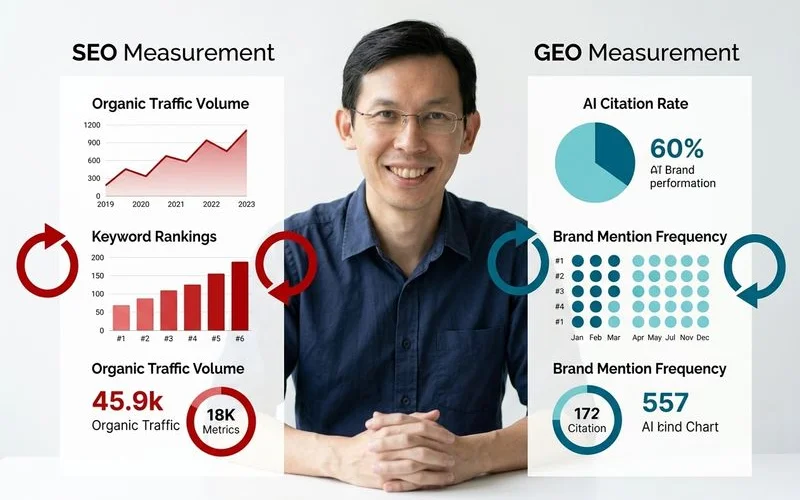
What are the core differences between these two strategies? The distinction between SEO vs Generative Engine Optimization comes down to intent. SEO drives click-through traffic from commercial queries on Google, while GEO secures brand citations during a buyer’s initial AI research phase. We use the comparison table below to track the distinct metrics, timelines, and tools required for each approach.
| Dimension | SEO | GEO |
|---|---|---|
| Surface | Google blue links + map pack | ChatGPT, Gemini, Perplexity, Claude, AI Overviews |
| Primary measurement | Clicks, conversions, rankings | AI citation rate, citation context, presence rate |
| Buyer intent stage | Decision-stage commercial queries | Research, comparison, exploratory queries |
| Speed to result | 6 to 12 months for compounding traffic | 8 to 16 weeks for citation rate movement |
| Substrate dependency | Foundational (owns the substrate) | Inherits substrate from SEO |
| Tool stack (ADE) | Agility Writer, EMDStriker | BrandPeek, GenCite Framework |
Why GEO is not a fad
GEO represents a permanent shift in digital marketing because consumer behaviour has fundamentally changed, and being cited by AI carries massive economic value. We see two structural reasons why the debate around ai search vs google search misses the bigger picture.
- User behaviour has shifted. A significant portion of buyer research now starts directly in AI engines, especially for high-consideration purchases like hiring a commercial roofing contractor or selecting B2B software. OpenAI reported a 330% spike in ChatGPT usage in Malaysia, and their launch of the affordable ChatGPT Go plan at RM38.99 per month proves this tool is fully mainstream. Global data also shows Google’s AI Overviews now trigger on over 58% of queries, drastically reducing traditional click-through rates.
- Citations have tangible economic value. Earning a citation from an AI engine when a user asks about your specific category creates immediate brand trust. For homeowners comparing expensive renovation options, this independent validation serves as a crucial touchpoint long before they ever click a website link.
Brands that ignore the AI surface are not saving their budget for what matters. They are actively losing their share of attention in a discovery layer that increasingly precedes the buyer’s classical search.
Why GEO depends on SEO
GEO relies entirely on a solid SEO foundation because AI models pull their answers from trusted, well-structured, and highly authoritative web sources. We constantly remind business owners that without basic search optimisation, an AI engine simply cannot verify your brand’s existence.
Here are the specific mechanics connecting the two:
- Trusted, structured sources: AI engines ground their answers in reliable information, which are usually the exact same sources that rank well in classical search results.
- Schema markup: The data layer classical SEO uses, such as Organization, Person, FAQ, and Product schema, is the exact same code AI engines parse to understand local business entities.
- Citation networks: Mentions of your brand on authoritative Malaysian platforms, like local business directories or news sites, feed both your classical authority and your AI trust score.
- Topical authority and content depth: The rigorous content disciplines SEO has rewarded for years are the same factors that drive AI selection and recommendation.
Brands equipped with weak SEO foundations rarely earn meaningful AI citations. Companies with strong SEO foundations get cited frequently, and they often achieve this without any explicit GEO work. GEO compounds the SEO investment, it does not replace it.
For a deeper answer on whether classical optimisation still justifies the cost, read Is SEO still effective in the AI search era?.
The strategic question Malaysian operators should ask
The critical question is not choosing between the two channels, but rather figuring out how to budget and execute for visibility across both platforms simultaneously. We suggest stepping away from an “SEO or GEO” mindset.
Instead, ask yourself:
“Where is my next decade of qualified search traffic and brand discovery going to come from, and what does my brand need to do today to be present in both layers?”
For most Malaysian business owners handling considered-purchase categories, from B2B services to major home renovations, the answer involves a hybrid approach:
- Maintaining and deepening your classical SEO investment, as your foundational data substrate matters more now than ever before.
- Adding a structured GEO investment via ADE GenCite at 10 to 20% of your total search marketing budget.
- Implementing AI visibility measurement via BrandPeek so you possess hard data on where your brand appears.
- Coordinating both of these layers under one single, accountable strategy.
Where ADE Marketing fits
Our team handles the execution of both traditional search and AI visibility campaigns. ADE Marketing runs the classical SEO layer and actively coordinates the GEO layer through ADE GenCite.
The GenCite Framework serves as the operational backbone of this AI visibility work. This proprietary 7-step methodology, developed by Adam Yong, ensures your brand gets cited accurately when homeowners or business clients research your category. We use this system to bridge the gap between traditional ranking metrics and modern AI recommendations.
A deliberate content-isolation note
This guide focuses intentionally on high-level strategy rather than technical execution. We do not detail AI-specific schema configuration, llms.txt patterns, AI Overview optimisation tactics, or citation-building specifics here. All of those tactical resources live on the ADE GenCite property. Keeping this content separate maintains a clean division between our strategic parent brand and our tactical AI division.
When you feel ready to scope a fully coordinated SEO and GEO program, Talk to ADE Marketing. You can also read the GEO services hub to start an AI-visibility specialist conversation.